4 Science-Backed Ways to Calm Your Body from Stress
Discover 4 effective science-backed methods for stress relief that can help calm your body in 20 minutes or less. Learn how to manage stress effectively and improve your well-being.
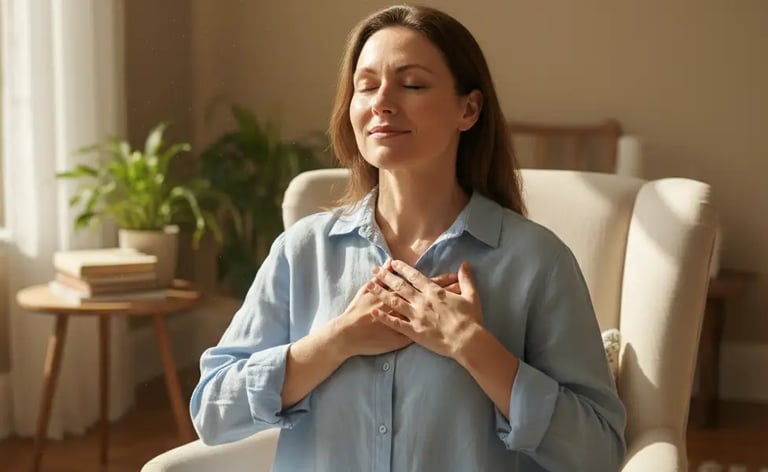

You're rushing between meetings, replying to texts at red lights, and planning dinner while listening to your kid's school day.
Your chest is tight.
Your jaw is clenched.
Your body has been screaming "STOP" for hours, but your mind keeps pushing.
Here's what most people miss: your body has its own stress-relief system built in.
You just forgot how to turn it on.
The Problem With "Just Relax"
But when you're juggling work, family, and everything else, finding time for stress relief feels impossible.
What if there were faster ways—backed by science—that actually work with your body's natural wiring?
There are.
And they take minutes, not hours.
4 Science-Backed Ways Your Body Can Calm Itself (That You're Not Using)
#1: Hum Your Way to Calm
Yes, really.
Humming activates your vagus nerve—the body's built-in relaxation superhighway that runs from your brain to your gut.
Research shows that humming may produce the lowest stress levels compared to physical activity, emotional stress, or even sleep.
When you hum, vibrations travel through your chest and head, triggering your parasympathetic nervous system (your body's "rest and digest" mode).
How to do it:
Sit comfortably
Inhale slowly through your nose for 3-4 seconds
Exhale for 6-8 seconds while making a steady "mmmmm" sound (like a bee)
Repeat for 15 minutes
Do this during your morning coffee, in the car before work, or while waiting in the school pickup line.
No equipment needed.
No judgment from anyone.
Just you and a simple sound.
#2: Tap Away Anxiety (Without Looking Weird)
Emotional Freedom Techniques (EFT)—or "tapping"—combines gentle fingertip pressure on specific facial and body points while acknowledging stressful thoughts.
It sounds strange.
It works anyway.
Studies show EFT may help reduce anxiety and depression symptoms, sometimes within a single session.
How to do it:
Take 3 deep breaths.
Identify your stressor (example: "I'm overwhelmed by work deadlines")
Tap the side of your hand (below your pinky) while saying: "Even though I feel [stressed/anxious/overwhelmed], I accept myself"
Tap these points 5-7 times each while repeating a short phrase ("this stress"):
Top of head
Beginning of eyebrow
Side of eye
Under eye
Under nose
Chin
Collarbone
Under arm
Takes 7-15 minutes.
You can do it in your parked car, at your desk, or before bed.
Repeat until you feel calmer.
#3: Listen to Nature Sounds (Even on Your Phone)
Your nervous system responds to sound differently than you think.
In a study of 40 participants, nature sound—specifically birdsong and fountain—was shown to help people recover from stress faster than urban noise.
Another study, involving 295 participants, found that birdsong alone produced similar benefits.
Your brain interprets birdsong as a "safe environment" signal.
Traffic noise?
Your brain stays on high alert.
How to do it:
Search YouTube or Spotify for "forest sounds," "birdsong," or "flowing water"
Put in earbuds for 5-20 minutes
Close your eyes if possible
Just listen
Do this during lunch breaks, while folding laundry, or before stressful conversations.
Your body will thank you.
#4: Breathe at Six Breaths Per Minute
Your heart and lungs have a built-in resonance frequency—a natural rhythm where they sync up perfectly.
Research with 76 adults in a 5-week study found that breathing at roughly six breaths per minute significantly reduced stress.
This is slower than your normal breathing rate (which is about 12-16 breaths per minute).
When you hit this rhythm, your heart rate variability increases, signaling your nervous system to relax.
How to do it:
Sit or lie down comfortably
Inhale slowly for 5 seconds
Exhale slowly for 5 seconds
That's one full breath cycle (10 seconds = 6 breaths per minute)
Continue for 10-20 minutes
No counting required once you find your rhythm.
You can do this at your desk, before bed, or during lunch breaks.
The study showed moderate to large stress reductions, with benefits appearing within weeks of daily practice.
The Truth Your Body's Been Trying to Tell You
You don't need more willpower.
You don't need to "think positive."
You need tools that work with your nervous system, not against it.
Your body already knows how to calm down.
These four techniques just help you remember.
Start with one.
Try it for a week.
Notice what changes.
Your Challenge:
Pick the method that sounds easiest.
Do it once today.
Right now if possible.
Your body's been waiting for you to listen.
Scientific References:
[1] Trivedi, G., Sharma, K., Saboo, B., et al. (2023). Humming (Simple Bhramari Pranayama) as a Stress Buster: A Holter-Based Study to Analyze Heart Rate Variability (HRV) Parameters During Bhramari, Physical Activity, Emotional Stress, and Sleep. Cureus, 15(4), e37527. https://pmc.ncbi.nlm.nih.gov/articles/PMC10182780/
[2] Church, D., Stapleton, P., Vasudevan, A., & O'Keefe, T. (2022). Clinical EFT as an evidence-based practice for the treatment of psychological and physiological conditions: A systematic review. Frontiers in Psychology, 13, 951451. https://www.frontiersin.org/journals/psychology/articles/10.3389/fpsyg.2023.1195286/full
[3] Alvarsson, J.J., Wiens, S., & Nilsson, M.E. (2010). Stress Recovery during Exposure to Nature Sound and Environmental Noise. International Journal of Environmental Research and Public Health, 7(3), 1036-1046. https://pmc.ncbi.nlm.nih.gov/articles/PMC2872309/
[4] Stobbe, E., Sundermann, J., Ascone, L., & Kühn, S. (2022). Birdsongs alleviate anxiety and paranoia in healthy participants. Scientific Reports, 12, 16414. https://www.nature.com/articles/s41598-022-20841-0
[5] van der Zwan, J.E., de Vente, W., Huizink, A.C., Bögels, S.M., & de Bruin, E.I. (2015). "Physical Activity, Mindfulness Meditation, or Heart Rate Variability Biofeedback for Stress Reduction: A Randomized Controlled Trial." Applied Psychophysiology and Biofeedback, 40(4), 257–268. https://pmc.ncbi.nlm.nih.gov/articles/PMC4648965/#Sec2
[6] Stapleton, P., Le Sech, K., Toussaint, L. L., & Hsieh, H. K. (2025). Effectiveness of a single emotional freedom techniques session on facilitating forgiveness and mental health: a randomized clinical trial. Cogent Psychology, 12(1). https://doi.org/10.1080/23311908.2025.2538740
Address
47 Macalister Lane, 10400 Georgetown, Pulau Pinang, Malaysia.
FDA Disclaimer
Results are not typical for everyone. Hoping you come across the solution that's just right for you.
Nothing on our website has been evaluated by the FDA or other medical bodies.
We're here to share educational wellness insights, not to replace medical advice and treatment, nor to diagnose, treat, cure, or prevent any health condition.
Think of our content as inspiration and information to discuss with your healthcare provider—not as a replacement for professional medical advice.
If you have health concerns, are pregnant or nursing, take medications, or manage a medical condition, please consult your doctor before making any changes based on what you read here.
Your health is unique to you, and your healthcare team knows you best.
We're just here to support your journey with research-backed information and encouragement.
Stay well! 💚
NouriEase is a brand of NOURISHED & ALIVE ENTERPRISE. All rights reserved.