What the Research Says About Slow Jogging at 180 Steps Per Minute (And Why Women Over 35 Are Paying Attention)
Discover the Japanese running method that prioritizes sustainability over speed—and what the science actually says about it.
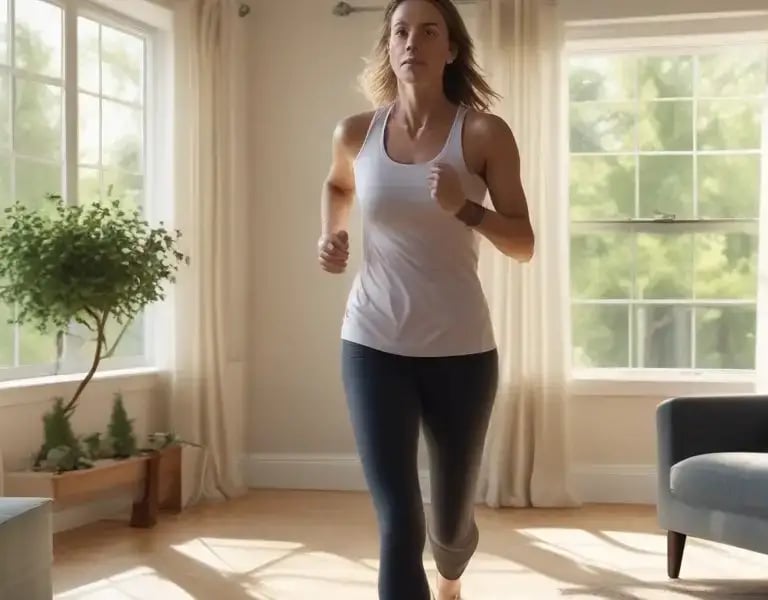
Your knees hurt after a run.
You try to jog at the park and feel winded after five minutes.
You wonder if running just isn't for you anymore.
Here's what the research suggests: you might be running too hard.
What Slow Jogging Actually Is
Slow jogging comes from Japan.
The approach combines a running method refined by Prof. Hiroaki Tanaka at Fukuoka University in Japan.
Prof. Hiroaki Tanaka adapted the 180 steps-per-minute cadence (popularized by running coach Jack Daniels after observing elite athletes at the 1984 Olympics) for sustainable, low-intensity training.
The concept is simple: run at a conversational pace while maintaining 180 steps per minute.
The key differences from regular jogging:
Much slower pace (you can chat comfortably)
Higher step frequency (180 steps per minute)
Lower impact on joints
Easier to sustain over time
Think of it as quick, light steps instead of long strides.
Your feet spend less time on the ground with each step.
Why exactly 180 steps per minute?
It's not magic—it's biomechanics.
When you take more, smaller steps instead of long, heavy strides, your knees and hips experience less impact force.
Think of it like the difference between stomping down stairs versus taking them lightly.
Recreational runners naturally take 164-180 steps per minute.
When they increase to 170-180 (just a 5-10% bump), the research is clear: less joint stress, less pain, easier recovery.
Your body figured out what scientists have now proven.
Is 180 the magic number?
Not exactly.
Studies don't ask people to hit 180 and stop there.
They ask runners to take about 5–10% more steps per minute than their natural pace — whatever that happens to be for them.
That small shift does something interesting.
When you take quicker, shorter steps, you land closer under your body instead of reaching out ahead of you.
Your foot hits the ground with less force.
Your knees absorb less of the shock.
Think of it like this: stomping down a staircase versus padding down lightly.
Same stairs.
Very different impact.
For a lot of recreational runners, that 5–10% bump lands near 180 steps per minute.
For others — shorter, taller, complete beginners — it might be 175 or 185.
So treat 180 as a target to experiment with.
Start by jogging at your natural pace for two minutes.
Count your steps.
Then try adding just a few extra steps per minute.
Keep the effort easy enough that you can still hold a conversation.
That's it.
What the Research Shows
Here's what actually happens to your body when you commit to slow jogging for 12 weeks.
Researchers at Fukuoka University studied 81 older adults with an average age of 70.8 years—people with low muscle mass.
Half did slow jogging for 90 minutes per week (alternating one minute of easy jogging with one minute of walking).
Half did nothing.
After 12 weeks, here's what changed in the slow jogging group:
Aerobic capacity improved by 15.7% (control group only improved 4.9%)
Sit-to-stand strength improved by 12.9% (getting out of a chair more easily—control group only 4.5%)
Subcutaneous fat decreased significantly—the fat you can feel under your skin
Intermuscular fat decreased significantly—the dangerous fat between muscle fibers that weakens you
The bottom line:
90 minutes of slow jogging per week—just 15-20 minutes per session if you do it 5-6 times a week—changed these older adults' bodies in three months.
That's a meaningful signal.
You don't need to be in a research lab for this to work.
You just need to be consistent.
Zone 2 Exercise
Zone 2 is where your heart starts to quicken a bit.
Your heart rate typically hover around 60%-70% of your maximum heart rate.
Zone 2 is the intensity level where you can sustain exercise while burning a high proportion of fat for fuel.
In plain English?
You can speak in full sentences without gasping.
Here's why this matters for women over 35:
Most of women swing between extremes.
They either push too hard (high-intensity workouts women abandon after two weeks) or go too easy (gentle walks that don't trigger fitness adaptations).
Zone 2 sits in the sweet spot—it's challenging enough that your cardiovascular system responds, but easy enough that you can actually sustain it three times next week.
Slow jogging is performed at a Zone 2 effort.
The combination of easy intensity with higher cadence reduces joint impact while maintaining aerobic benefits.
What this might mean for you:
The approach may support cardiovascular health at lower intensities than traditional running.
Joint impact appears reduced compared to standard jogging techniques.
The method may be easier to maintain long-term because it doesn't leave you exhausted.
Recovery time between sessions may be shorter.
At low intensities, your body preferentially uses fat for energy.
The Fukuoka study showed that 90 minutes of slow jogging per week for 12 weeks produced significant decreases in both subcutaneous fat (fat under your skin) and intermuscular fat (dangerous fat between muscle fibers).
Why this matters specifically after 35.
After menopause — and even in perimenopause — changes in estrogen affect how your body stores fat, regulates blood pressure, and processes blood sugar.
Exercise becomes less optional and more protective.
Slow jogging in Zone 2 fits that description.
The ACSM and CDC both recommend 150 minutes of moderate-intensity aerobic activity per week for adults.
Five 20-minute slow jogs and two 30-minute brisk walks gets you there.
No gym required.
Why This Might Appeal to You After 35
You have about 47 things on your to-do list today.
Exercise needs to fit into your life, not dominate it.
Here's what makes slow jogging practical:
Time efficiency — A 20-minute session counts. No need for hour-long workouts.
Joint considerations — The lighter impact may reduce stress on knees and ankles.
Accessibility — No gym membership needed. No special equipment beyond decent shoes.
Realistic entry point — You can start regardless of current fitness level.
Schedule flexibility — Early morning. Lunch break. Evening. Your choice.
What if your knees are already a problem?
Slow jogging is lower impact than regular running.
But lower impact doesn't mean zero impact.
Researchers found that when you jog slowly over a longer distance, each step is gentler.
However, your total knee load over that distance can be similar to running faster, since you take more steps to cover the same ground.
What that means practically: don't start by going long.
Start short.
If your knees, hips, or ankles already give you trouble, try 5–8 minutes first.
See how they feel the next day.
That 24-hour window is your real feedback, not how you feel mid-run.
Before You Start: What to Consider
Talk to your doctor first.
This isn't negotiable if you have existing health conditions.
Starting guidelines:
Begin with 10-minute sessions if you're new to running.
Find your natural pace by talking out loud while jogging.
If you can't speak in complete sentences, you're going too fast.
Track your steps per minute using your phone or watch.
Most fitness trackers measure cadence automatically.
Listen to the 24-hour rule:
Mild muscle fatigue the next morning is normal.
Sharp joint pain, swelling, or pain that gets worse session by session — that's a sign to scale back and check with your doctor.
If you're on medication for blood pressure, diabetes, or heart conditions, ask your doctor whether to monitor your heart rate more closely as you add weekly minutes of Zone 2 exercise.
How Much Should You Actually Do?
The Fukuoka University research used 90 minutes of slow jogging per week and found significant body composition and fitness improvements in just 12 weeks.
Here's what that means:
Minimum to see changes: 60-90 minutes per week (three 20-30 minute sessions)
Sweet spot: 90-120 minutes per week (four or five 20-minute sessions)
More is optional: Benefits plateau—doubling volume doesn't double results
Start with what you can actually do consistently.
Better to do 20 minutes five times a week for 12 weeks than 45 minutes once and quit.
Equipment needs:
Decent running shoes (not necessarily expensive ones).
Comfortable clothing.
A way to track time and steps.
Free Apps for 180 Steps Per Minute
Several free apps can help you maintain the 180 step rhythm:
Quick Steps (iOS) — Plays a beat at 180 steps per minute. Free version works perfectly for slow jogging.
Slow Jogging Tracker & Timer (Android) — Includes 180 BPM beat music and step counter.
Running Metronome & Timer (Android) — Offers beat-driven tracks at 180 BPM and beyond.
Your existing fitness tracker — Most Garmin, Apple Watch, and Fitbit devices already track cadence automatically.
You can also search music streaming services for "180 BPM" playlists.
Match your steps to the beat.
The rhythm helps maintain consistency.
Your move:
Pick five days next week.
Same time.
Just 20 minutes.
You're already in the research zone.
Scientific References:
Tanaka H, Jackowska M. Slow jogging - a multi-dimensional approach to physical activity in the health convention. Journal of Kinesiology and Exercise Sciences. (2019);29(86):11-17. https://doi.org/10.5604/01.3001.0013.7810.
Tanaka, H., & Jackowska, M. (2016). Slow jogging: Lose weight, stay healthy, and have fun with science-based, natural running. Skyhorse Publishing.
Ikenaga M, Yamada Y, Kose Y, Morimura K, Higaki Y, Kiyonaga A, Tanaka H; Nakagawa Study Group. Effects of a 12-week, short-interval, intermittent, low-intensity, slow-jogging program on skeletal muscle, fat infiltration, and fitness in older adults: randomized controlled trial. Eur J Appl Physiol. 2017 Jan;117(1):7-15. doi: 10.1007/s00421-016-3493-9. Epub 2016 Nov 15. PMID: 27848017.
Chumanov ES, Wille CM, Michalski MP, Heiderscheit BC. Changes in muscle activation patterns when running step rate is increased. Gait Posture. 2012 Jun;36(2):231-5. doi: 10.1016/j.gaitpost.2012.02.023. Epub 2012 Mar 17. PMID: 22424758; PMCID: PMC3387288.
Figueiredo I, Reis E Silva M, Sousa JE. The Influence of Running Cadence on Biomechanics and Injury Prevention: A Systematic Review. Cureus. 2025 Aug 17;17(8):e90322. doi: 10.7759/cureus.90322. PMID: 40964543; PMCID: PMC12440572.
Easy Does It: Why You Should Target Zone 2 Cardio Workouts. Cleveland Clinic. 2025 Oct.
https://health.clevelandclinic.org/zone-2-cardio
Figueiredo I, Reis E Silva M, Sousa JE. The Influence of Running Cadence on Biomechanics and Injury Prevention: A Systematic Review. Cureus. 2025 Aug 17;17(8):e90322. doi: 10.7759/cureus.90322. PMID: 40964543; PMCID: PMC12440572.
Garber CE, Blissmer B, Deschenes MR, Franklin BA, Lamonte MJ, Lee IM, Nieman DC, Swain DP; American College of Sports Medicine. American College of Sports Medicine position stand. Quantity and quality of exercise for developing and maintaining cardiorespiratory, musculoskeletal, and neuromotor fitness in apparently healthy adults: guidance for prescribing exercise. Med Sci Sports Exerc. 2011 Jul;43(7):1334-59. doi: 10.1249/MSS.0b013e318213fefb. PMID: 21694556.
Centers for Disease Control and Prevention. Adult Physical Activity Guidelines. 2025. https://www.cdc.gov/physical-activity-basics/guidelines/adults.html
Petersen J, Sørensen H, Nielsen RØ. Cumulative loads increase at the knee joint with slow-speed running compared to faster running: a biomechanical study. J Orthop Sports Phys Ther. 2015 Apr;45(4):316-22. doi: 10.2519/jospt.2015.5469. Epub 2015 Jan 1. PMID: 25552288.
Address
47 Macalister Lane, 10400 Georgetown, Pulau Pinang, Malaysia.
FDA Disclaimer
Results are not typical for everyone. Hoping you come across the solution that's just right for you.
Nothing on our website has been evaluated by the FDA or other medical bodies.
We're here to share educational wellness insights, not to replace medical advice and treatment, nor to diagnose, treat, cure, or prevent any health condition.
Think of our content as inspiration and information to discuss with your healthcare provider—not as a replacement for professional medical advice.
If you have health concerns, are pregnant or nursing, take medications, or manage a medical condition, please consult your doctor before making any changes based on what you read here.
Your health is unique to you, and your healthcare team knows you best.
We're just here to support your journey with research-backed information and encouragement.
Stay well! 💚
NouriEase is a brand of NOURISHED & ALIVE ENTERPRISE. All rights reserved.