Menopause and Your Gut: What's Really Happening Inside
Your hormones shifted. So did your gut bacteria. Here's what science reveals about the connection—and what you can do about it.
Your Hormones Aren't the Problem. Your Gut Is.
You're eating Mediterranean.
Sleeping eight hours.
Managing stress.
Still stuck at the same weight.
Still battling hot flashes.
Still feeling... off.
Here's what your doctor probably didn't tell you: Your gut bacteria produce an enzyme that literally recycles the estrogen your liver tried to eliminate.
This changes everything.
The Enzyme Your Body Forgot to Mention
Some Gut bacteria produce beta‑glucuronidase, an enzyme that peels off the liver’s wrapper from estrogen so the hormone can be absorbed into your bloodstream again.
Translation?
Your gut decides how much estrogen stays in circulation.
Not your ovaries. Not your liver.
Your gut bacteria.
Scientists call this collection of estrogen-metabolizing bacteria the "estrobolome."
When your gut bacteria are diverse and balanced, they help maintain physiological estrogen levels through this recycling process.
When they're not?
Dysbiosis reduces beta-glucuronidase activity, accelerating menopause symptoms.
Low diversity = less enzyme = less estrogen recycled = more symptoms.
Why You're Doing Everything Right But Still Feel Wrong
You've optimized your diet.
You're exercising (knee pain willing).
You've cut sugar, added protein, tracked your sleep.
If your gut microbiome is depleted, it means the helpful bacteria in your gut are reduced.
Most women over 35 have some level of dysbiosis, which is an imbalance in those gut microbes.
That imbalance can change circulating estrogen levels in your body.
Changes in estrogen can contribute to metabolic syndrome and weight gain.
It can also make menopause symptoms worse.
Your gut bacteria influence mood, behavior, energy, weight, food cravings, hormone balance, immunity, and overall wellness.
Everything connects back to the gut.
The Missing Food Group No One Talks About
Fermented foods.
Not probiotics in a pill.
Not supplements.
Real food.
Fermented foods may cause significant positive improvements in balancing intestinal permeability and barrier function.
Think:
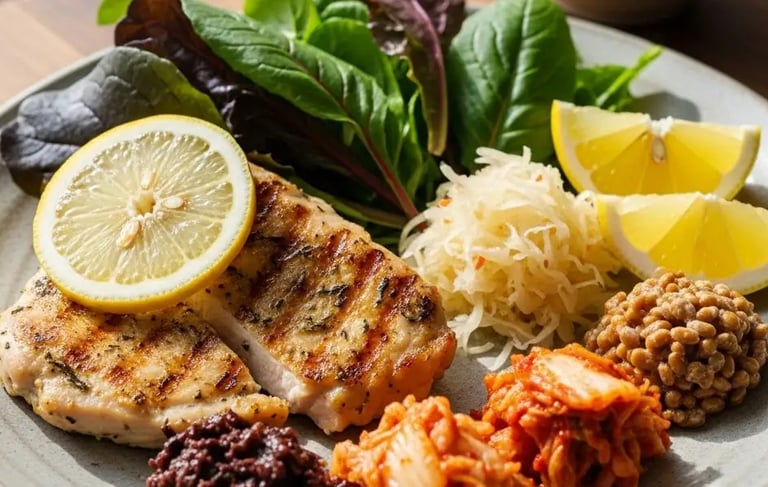
Sauerkraut
Kimchi
Miso
Kefir
Natto
Recent studies found that eating fermented vegetables changes the mix of bacteria in your gut.
It boosts bacteria that make butyrate, a helpful fatty acid that feeds your gut lining.
Those bacteria also tend to be anti‑inflammatory, which can calm gut irritation.
In short: fermented veggies help grow better, inflammation‑fighting microbes in your gut.
These aren't exotic superfoods.
They're what humans ate for thousands of years before refrigeration.
One Food Complements Weight-Bearing Exercise
Natto is fermented soybeans.
Sticky texture.
Mild taste.
Sounds weird, works anyway.
Here's why it matters for your bones:
Natto contains vitamin K2 (MK-7)—about 350 micrograms per small serving (40g).
K2 activates a protein called osteocalcin.
Osteocalcin tells your bones how to use calcium.
No K2 = calcium can't stick to bone.
A 15-year study of 1,417 postmenopausal Japanese women found those eating seven or more packs of natto weekly (40 grams each) had 44% lower fracture risk compared to women eating less than one pack per week.
44%.
From food.
The practical dose:
Seven servings per week = best protection.
That's one small pack (40g) daily, or 2 packs 3-4 times weekly.
Find it refrigerated in Asian grocery stores.
Mix with rice, soy sauce, egg, mustard, green onion.
Heat kills the bacteria—eat it cold or room temperature.
The Practical Part (No Perfection Required)
You don't need to eat like you live in Tokyo.
You need doable.
Start with one fermented food per day:
Week 1: Add 1-2 tablespoons of sauerkraut or kimchi to lunch or dinner.
No cooking required. Straight from the jar.
Week 2: Try kefir (dairy or non-dairy) at breakfast.
Mix with berries for polyphenols that may stimulate beneficial bacteria like Akkermansia muciniphila.
Week 3: Experiment with miso.
Dissolve 1 teaspoon in warm water for instant broth. Don't boil—heat kills the live bacteria.
Natto (if you're serious about bones):
Eating seven 40‑gram packs of natto per week was linked with significantly lower risk of osteoporotic fractures.
Mix with rice, egg, soy sauce, and green onion.
Look for refrigerated fermented foods with "live cultures" on the label.
Avoid pasteurized versions—the heat kills the bacteria you need.
The Part About Not Being Perfect
You won't eat fermented foods every day.
You'll forget. You'll travel.
That's fine.
Consistency beats perfection.
Five times a week beats zero times a week for its potential in boosting body health.
Why Your Doctor Hasn't Mentioned This
Because the connection between gut microbiota and estrogen metabolism is relatively recent science, with most research emerging in the past decade.
But the evidence is there.
Published.
Peer-reviewed.
Reproducible.
The Truth You Need to Hear
You're not broken.
Your hormones aren't the enemy.
Your gut bacteria—depleted by decades of antibiotics, stress, processed food, and lack of fiber—just need support.
How you digest food, your mood, energy, weight, food cravings, hormone balance, and immunity are all linked to gut health.
One jar of kimchi won't fix everything overnight.
But it's a start.
A real, actionable, scientifically-backed start.
Your Next Move
Go to your grocery store.
Walk to the refrigerated section.
Buy one jar of sauerkraut, kimchi, or miso.
Eat 1-2 tablespoons with your next meal.
That's it.
No perfection.
No all-or-nothing.
No waiting until you "have time to do it right."
Your gut—and your hormones—have been waiting long enough.
Scientific References
Hu S, Ding Q, Zhang W, Kang M, Ma J, Zhao L. Gut microbial beta-glucuronidase: a vital regulator in female estrogen metabolism. Gut Microbes. 2023 Jan-Dec;15(1):2236749. doi: 10.1080/19490976.2023.2236749. PMID: 37559394; PMCID: PMC10416750.
Bell V, Ferrão J, Pimentel L, Pintado M, Fernandes T. One Health, Fermented Foods, and Gut Microbiota. Foods. 2018 Dec 3;7(12):195. doi: 10.3390/foods7120195. PMID: 30513869; PMCID: PMC6306734.
Kojima, A., Ikehara, S., Kamiya, K., Kajita, E., Sato, Y., Kouda, K., Tamaki, J., Kagamimori, S., & Iki, M. (2020). Natto Intake is Inversely Associated with Osteoporotic Fracture Risk in Postmenopausal Japanese Women. The Journal of Nutrition, 150(3), 599–605. https://doi.org/10.1093/jn/nxz292
Van Buiten CB, Seitz VA, Metcalf JL, Raskin I. Dietary Polyphenols Support Akkermansia muciniphila Growth via Mediation of the Gastrointestinal Redox Environment. Antioxidants (Basel). 2024 Feb 29;13(3):304. doi: 10.3390/antiox13030304. PMID: 38539838; PMCID: PMC10967430.
Valentino V, Magliulo R, Farsi D, Cotter PD, O'Sullivan O, Ercolini D, De Filippis F. Fermented foods, their microbiome and its potential in boosting human health. Microb Biotechnol. 2024 Feb;17(2):e14428. doi: 10.1111/1751-7915.14428. PMID: 38393607; PMCID: PMC10886436.
Address
47 Macalister Lane, 10400 Georgetown, Pulau Pinang, Malaysia.
FDA Disclaimer
Results are not typical for everyone. Hoping you come across the solution that's just right for you.
Nothing on our website has been evaluated by the FDA or other medical bodies.
We're here to share educational wellness insights, not to replace medical advice and treatment, nor to diagnose, treat, cure, or prevent any health condition.
Think of our content as inspiration and information to discuss with your healthcare provider—not as a replacement for professional medical advice.
If you have health concerns, are pregnant or nursing, take medications, or manage a medical condition, please consult your doctor before making any changes based on what you read here.
Your health is unique to you, and your healthcare team knows you best.
We're just here to support your journey with research-backed information and encouragement.
Stay well! 💚
NouriEase is a brand of NOURISHED & ALIVE ENTERPRISE. All rights reserved.